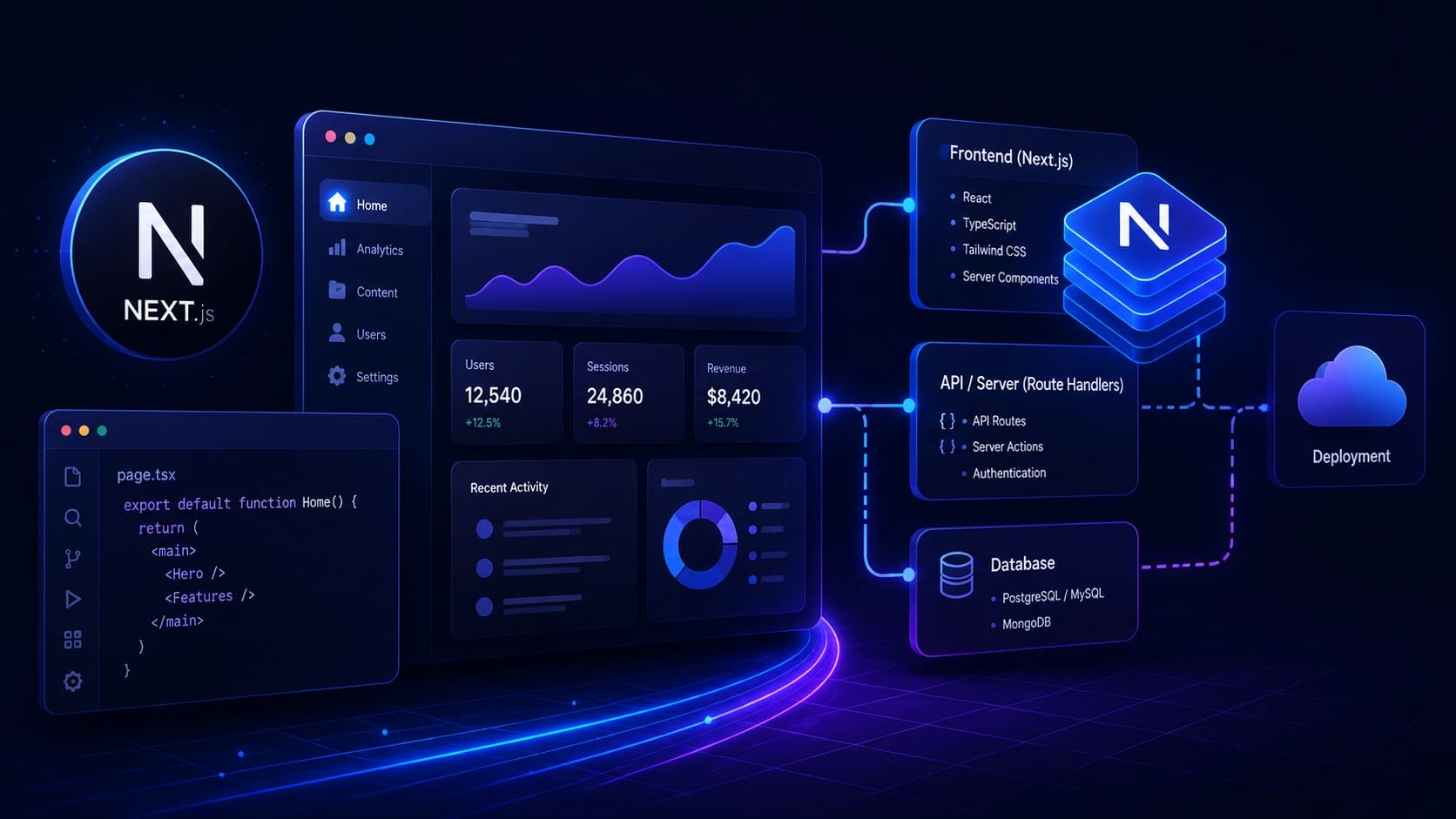
Modern web development has changed a lot.
Today, building applications is not only about creating user interfaces. Applications need performance, good user experience, SEO, reliable data handling, and smooth deployment workflows.
This is one reason why Next.js has become one of the most popular choices in the React ecosystem.
React is the foundation, Next.js completes the workflow
React is excellent for building interfaces, components, and interactive experiences.
But most real-world applications need more:
- Routing
- Server rendering
- Data fetching
- Backend communication
- Performance optimization
- Deployment structure
Next.js provides these features as part of the framework instead of forcing every project to solve them separately.
Server-side capabilities matter
Modern applications often need to communicate with databases, APIs, and external services.
Next.js makes this easier with features like:
- Server Components
- Server Actions
- API routes
- Server-side rendering
This allows developers to build applications where frontend and backend work together naturally.
Performance is part of the architecture
Performance is not something that should only be fixed at the end of a project.
Next.js provides built-in features for:
- Image optimization
- Code splitting
- Streaming
- Faster page loading
- Better user experience
Good architecture helps applications stay fast as they grow.
Developer experience improves productivity
A good framework should help developers build better software faster.
Next.js provides:
- File-based routing
- TypeScript support
- Full-stack patterns
- Modern deployment workflows
These features reduce repetitive setup work and allow developers to focus on solving actual problems.
Choosing the right tool
Next.js is not the answer for every project.
Simple websites, content platforms, and traditional CMS projects may need different solutions.
But for modern applications that require flexibility, performance, and full-stack capabilities, Next.js provides a strong foundation.
The best developers do not just follow trends — they understand the problem and choose tools that fit.